
 EN
EN

Split / Assembled PC Lightsaber Blade
Split (Assembled) PC Blade This is the most common industry standard structure.
Composition: Composed of an Extruded PC Tube and a separate Injection Molded PC Tip.
Connection Process: To prevent tip detachment, standard glue is prohibited. The industrial standard employs Chemical Solvent Welding or Threaded Mechanical Locking.
Physical Advantages:
Optical Optimization: The separate injected tip can house internal mirrors or light-guiding textures and is free from the flow marks caused by thermal forming, offering superior clarity.
Precision: The extruded body ensures cylindricity and straightness along the entire length, avoiding the draft angle issues inherent in injection molding.
Technical Analysis of Lightsaber Blade Tips
In the split-blade assembly, the Blade Tip is the core component determining safety, aesthetic integrity, and durability. As an independent physical part, its design and assembly process directly dictate the structural stability of the lightsaber during high-speed swinging and impact.
Geometric Classification
Based on differing aesthetic pursuits and safety regulations, the industry primarily offers two standard tip geometries.
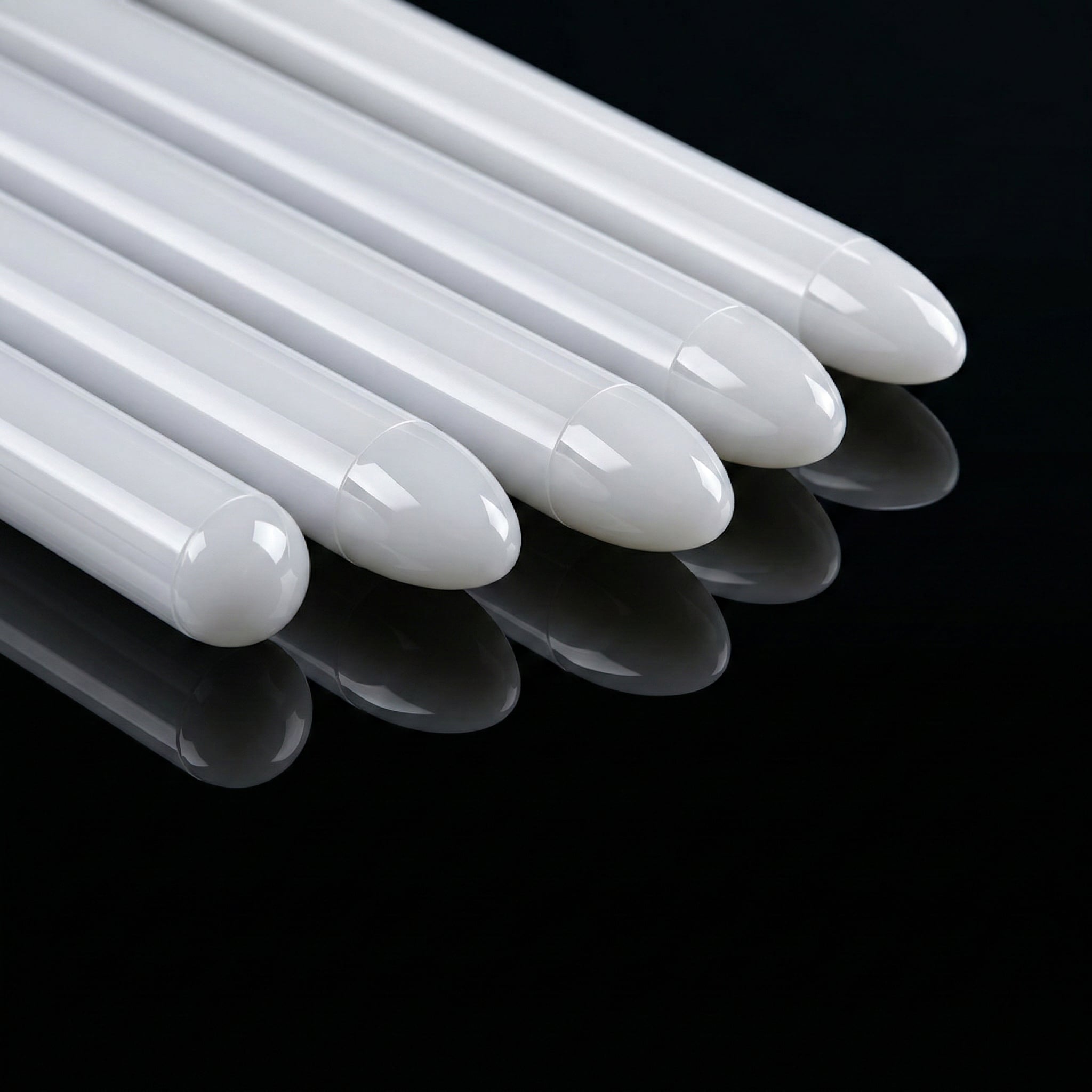
Bullet Tip
Aesthetic Features: Features a parabolic or conic section design, offering a slender and streamlined profile.
Application: Visually, this shape best matches the extension of the energy beam seen in the Star Wars films, offering superior streamlined aesthetics. It is often used for Prop Replicas and solo Flow Arts.
Round / Parabolic Tip
Safety Logic: This is the industry standard for combat-grade sabers. According to the pressure formula (P=F/A), a round tip offers a larger Contact Surface Area compared to a bullet tip. Under equal swing force, it significantly reduces the pressure applied to an opponent, thereby maximizing safety against blunt force trauma.
Application: A mandatory safety configuration for lightsaber combat clubs and Full-Contact Dueling.
Material Science: Material & Color Consistency
The Material Red Line: PC vs. Acrylic
Mandatory Injection Molded PC: Tips must use Injection Molded Polycarbonate. The high impact toughness of PC ensures elastic deformation rather than fracture upon impact.
Prohibition of CNC Acrylic: Some low-end manufacturers use CNC-machined Acrylic (PMMA) tips. Acrylic is inherently brittle, and micro-tool marks from CNC machining act as stress concentration points. In combat, such tips shatter easily, creating sharp, glass-like projectiles that pose a severe hazard.
Optical Consistency: Color Matching
Visual Logic: The Color and Haze of the tip material must strictly match the PC Tube.
Aesthetic Impact: Any color discrepancy (e.g., a bluish tube with a yellowish tip) creates a jarring visual disconnect, ruining the integrity of the lightsaber as a "pure energy beam." High-end manufacturing standards require tips and tubes to use the same batch or color code of PC pellets to ensure visual seamlessness.
Evolution & Challenges of Connection Technology
"Tip Projectile Hazard" has been a long-standing industry pain point. Conventional solutions all suffer from significant flaws.
Heat Shrink Sleeve: While it prevents detachment, it looks like a patch, severely compromising aesthetics. Considered only a temporary fix.
Threaded Locking:
Pros: Allows users to swap between round and bullet tips.
Fatal Flaws: Demands extreme machining precision. Shallow threads lead to stripping; deep threads or poor precision cause micro-cracks in the tube wall. Under repeated impact vibration, these cracks propagate rapidly, causing the tube end to shatter and the tip to fly off.
Standard Glue / Ultrasonic: Ordinary glue cannot withstand shear forces; ultrasonic welding struggles with deep fusion in thick-walled PC tubes. These are proven ineffective for permanently solving the detachment issue.
The Ultimate Solution: Barbed Solvent Press-Fit
Addressing the industry challenge of "how to permanently lock the PC tip," the optimal solution, theoretically and practically verified, is a Composite Connection Process combining mechanical locking and chemical fusion.
Structural Design
Barbs & Chamfer: The injection-molded PC tip must be custom-tooled.
Chamfer: A lead-in chamfer at the base facilitates alignment.
Barbed Structure: Crucially, the sidewalls feature micro Uni-directional Barbs or annular serrations. This provides a physical "easy-in, hard-out" characteristic.
Glue Reservoir: Dedicated grooves are designed between the barbs to hold the solvent.
Assembly Process
Cold Welding Solvent: Specialized PC solvent (e.g., Dichloromethane) is applied to the grooves. Note: This is not glue, but a chemical agent that dissolves PC polymer chains.
Hydraulic Press Fit: A hydraulic or high-pressure pneumatic press forces the tip into the PC tube.
Dual Locking Principle:
Physical Lock: The barbs bite into the inner tube wall, providing immense mechanical resistance to pull-out.
Chemical Lock: The solvent dissolves and re-crosslinks the PC molecules of both the tip and the tube wall. Once evaporated, they fuse into a single material at the molecular level.
Current Limitations & Future Outlook
Despite the safety solution provided by the "Barbed Solvent Press-Fit" process, the Split-Type Structure itself suffers from insurmountable aesthetic flaws.
Regardless of precision, a physical boundary always exists between the tip and the tube. When illuminated, due to the abrupt change in refractive index and physical blockage, a visible Seam Line or Light Ring inevitably appears.
While split-type is currently mainstream, the industry's ultimate vision is the widespread adoption of the Monolithic (Integrated) Blade. This seamless, shadow-free, and structurally perfect form represents the next milestone in lightsaber manufacturing technology.